LLM Systems 04: GPU Acceleration
0. Recap
- Basic GPU CUDA operations
- memory allocation
- data movement
- creating threads and running on SMs
- specifying number of threads and number of blocks in a grid
- referring to data in GPU memory within a thread
- using building index variables to refer to the data
1. Tiling
A100 80G PCIe GPU 规格
| FP32 | 19.5 TFLOPS |
|---|---|
| Tensor Core Float 32 | 156 TFLOPS |
| GPU Memory Bandwidth | 1,935 GB/s |
- 每秒 FLOPS 数不仅仅受限于计算单元理论上限,也可能受限于内存访问操作
- 计算访存比(Compute-to-global-memory-access-ratio)
- 每字节 global memory 访问对应的 FLOPs 数量
- 对于朴素矩阵乘法实现(每个线程负责输出矩阵一个元素)
- man loop:
for (int k = 0; k < N; k++) Pvalue += a[row * N + k] * b[k * N + col]; - 每次循环完成乘加两次浮点运算,访问两个 float 共 8 字节
- compute-to-global-memory-access: 2 / (2 * 4) = 0.25 FLOP/B
- man loop:
不同存储访问效率
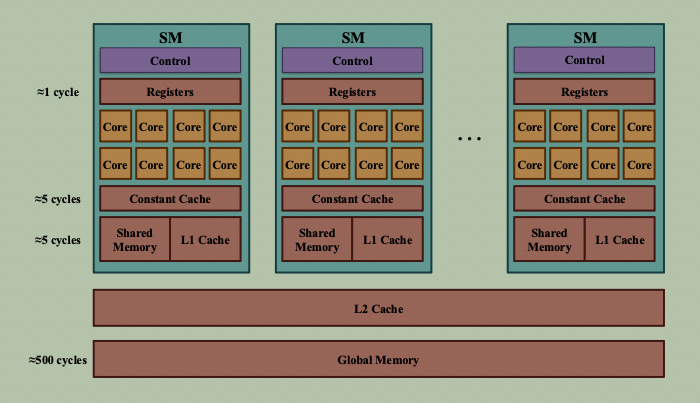
- register:约 1 时钟周期
- constant cache:5
- shared memory/L1 cache:5
- L2 cache:200 ~ 300
- global memory:500
对于如下 kernel 代码:
1 | |
其对应的 GPU 指令:
1 | |
- 从 global memory 读取数据的时间远长于实际计算的时间
GPU 内存模型
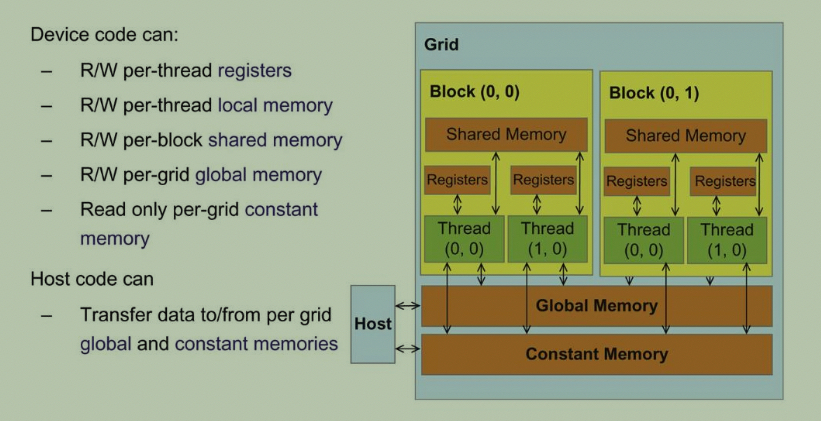
不同 memory type 变量声明:
| 变量声明 (Variable declaration) | 内存 (Memory) | 作用域 (Scope) | 生命周期 (Lifetime) |
|---|---|---|---|
int var; |
Register | Thread | Grid |
int varArr[N]; |
Local | Thread | Grid |
__device__ __shared__ int SharedVar; |
Shared | Block | Grid |
__device__ int GlobalVar; |
Global | Grid | Application |
__device__ __constant__ int constVar; |
Constant | Grid | Application |
Tile Matrix Multiply kernel
主要步骤:
- load the first tile of each input matrix to shared memory
- each thread in the thread block loads one element
- wait for loading using
__syncthreads()
- each thread in the thread block computes the partial sum from the
tiles in shared memory, threads wait for each other to finish
- wait for completing compute using
__syncthreads()
- wait for completing compute using
- load the next tile of each input matrix to shared memory (iterate over the reduction dimension tile by tile)
- write the final result to global memory
2. Memory Parallelism
Memory Restriction
| GPU | NVIDIA H100 | NVIDIA A100 |
|---|---|---|
| FP32 | 67 teraFLOPS | 19.5 teraFLOPS |
| Memory | 80GB HBM3 | 80GB HBM2e |
| Memory Bandwidth | 3.35TB/s | 2TB/s |
| SMs | 132 | 104 |
| Shared memory per SM | 256K | 192K |
| Registers per SM | 64K | 64K |
- shared memory 和 register 资源尤其有限
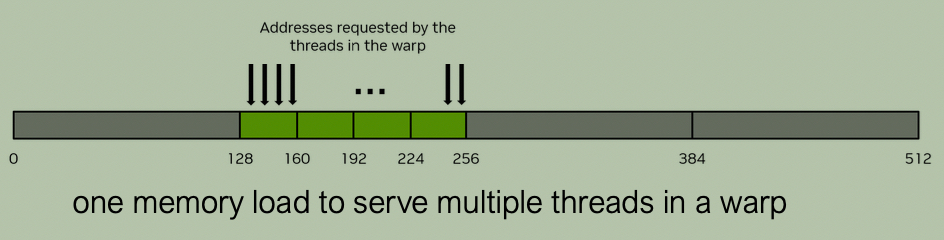
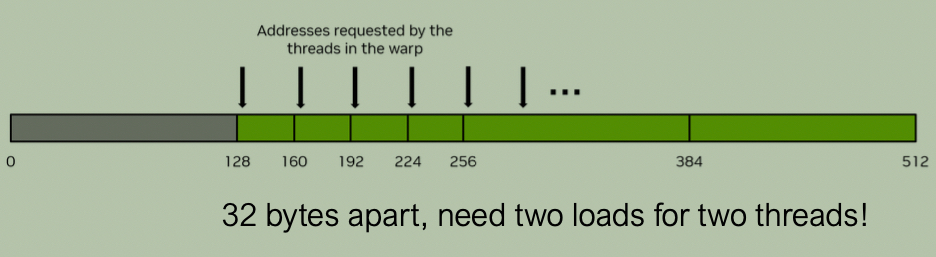
global memory 的访问要注意做到合并访问(Coalesced):
- 合并访问:高效
- 非合并访问:低效
矩阵转置
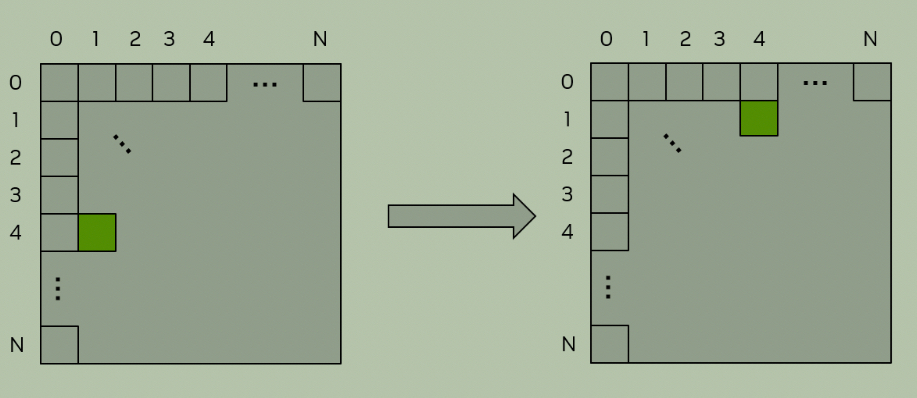
naive 实现:
1 | |
- 读取
a(合并访问):a[INDX(myRow, myCol, m)]中,连续的threadIdx.x对应连续的myCol。- 同一 warp 内的线程访问
a的同一行连续元素 → 读取是合并的(coalesced)。
- 写入
c(非合并访问):c[INDX(myCol, myRow, m)]中,连续的myCol对应c的连续行。- 同一 warp 内的线程写入
c的同一列不同行 → 地址跨度为m(矩阵宽度)。 - 写入是非合并的(uncoalesced),会导致严重的带宽浪费。
- 优化方向:
- 使用 shared memory tiling(分块转置)。
- 以合并方式从
a读取一个 tile 到 shared memory,再以合并方式从 shared memory 写入c,从而将 global memory 的读写都变成合并访问。
利用 shared memory 优化版本实现:
核心思想:
- 解决方案:将矩阵分块(tile),每个 block 负责一个 tile。
- 步骤:
- 以合并方式从全局内存读取一个 tile 到 shared
memory(连续的
threadIdx.x访问连续列)。 - 在 shared memory 中完成转置(或任意重排)。shared memory 是片上 SRAM,不需要合并访问,延迟低。
- 以合并方式将转置后的 tile 从 shared memory 写回全局内存。
- 以合并方式从全局内存读取一个 tile 到 shared
memory(连续的
- 效果:全局内存的读和写都变成合并访问,只有 shared memory 内部存在非连续访问,但代价小得多。
Coalesced 矩阵转置代码:
1 | |
关键点分析:
- 读取
a:threadIdx.x连续 →tileCol + threadIdx.x连续 → 同一行连续列 → 合并。 - 写入
c:threadIdx.x连续 →tileRow + threadIdx.x连续 → 同一行连续列 → 合并。 - 转置在 shared memory 内完成:
- 写入 shared
memory:
smemArray[threadIdx.x][threadIdx.y] - 读取 shared
memory:
smemArray[threadIdx.y][threadIdx.x] - 两者互为转置,且 shared memory 无需合并,非连续访问代价低。
- 写入 shared
memory:
- 为什么
smemArray声明为[X][Y]而不是[Y][X]?- 这个 shared memory 数组保存的是 转置后的 tile。
- 写入时:
smem[tx][ty] = A[ty][tx],即 A 的行变成 smem 的列。 - 读取时:
smem[ty][tx] = C[ty][tx],再写回 C 的同一行。 - 这种布局使得:
- 从 A 读:
tx连续 → A 同一行连续列 → 合并。 - 写回 C:
tx连续 → C 同一行连续列 → 合并。
- 从 A 读:
- 转置存储让全局内存两端的访问方向都被“转正”,只有 shared memory 内部发生非连续访问,代价小得多。
- 若按常规
[Y][X]声明,读取 smem 时tx会映射到行,导致写回 C 时地址跨步,丧失合并。
__syncthreads():确保 tile 完全加载到 shared memory 后,再进行写回。
以一个 tile 为例,第一阶段从 A 读到 shared memory:
1 | |
第二阶段从 shared memory 写到 C:
1 | |
从线程视角看不同阶段线程如何 load/store/与 shared memory 交互:
以 4×4 tile、块 (0,0) 为例。每个线程 (tx, ty)
只做四件事:
| 线程 (tx, ty) | 从 A 读取 | 写入 shared memory | 从 shared memory 读取 | 写入 C |
|---|---|---|---|---|
| (0,0) | A[0][0] | smem[0][0] = A[0][0] | smem[0][0] = A[0][0] | C[0][0] = A[0][0] |
| (1,0) | A[0][1] | smem[1][0] = A[0][1] | smem[0][1] = A[1][0] | C[0][1] = A[1][0] |
| (2,0) | A[0][2] | smem[2][0] = A[0][2] | smem[0][2] = A[2][0] | C[0][2] = A[2][0] |
| (3,0) | A[0][3] | smem[3][0] = A[0][3] | smem[0][3] = A[3][0] | C[0][3] = A[3][0] |
| (0,1) | A[1][0] | smem[0][1] = A[1][0] | smem[1][0] = A[0][1] | C[1][0] = A[0][1] |
| (1,1) | A[1][1] | smem[1][1] = A[1][1] | smem[1][1] = A[1][1] | C[1][1] = A[1][1] |
只看前两行,就能发现规律:
- 读取 A:线程
(tx, ty)读A[ty][tx]。- 同一行
ty的线程(tx=0,1,2,3)读 A 的同一行连续列 → 合并。
- 同一行
- 写入 smem:线程
(tx, ty)写smem[tx][ty]。- 这是转置存储:A 的行变成 smem 的列。
- 读取 smem:线程
(tx, ty)读smem[ty][tx]。- 对于
ty相同的一组线程,协作读取 shared memory 的一行元素,对应 A 的一列的 tile。
- 对于
- 写入 C:线程
(tx, ty)写C[ty][tx]。ty相同的同一行线程写 C 的同一行连续列 → 合并。
- 每个线程只做四件事:
- 读 A:线程 (tx, ty) 读
A[ty][tx]→ tx 连续 → 合并。 - 写 smem:线程 (tx, ty) 写
smem[tx][ty]→ 转置存储(A 的行变成 smem 的列)。 - 读 smem:线程 (tx, ty) 读
smem[ty][tx]→ 等价于读A[tx][ty],正好是写入 C 所需的值。 - 写 C:线程 (tx, ty) 写
C[ty][tx]→ tx 连续 → 合并。
- 读 A:线程 (tx, ty) 读
Bank Conflict
- shared memory 有 32 个 banks,每个 bank 宽 4 字节。
- 一个 warp 有 32 个线程。如果这 32 个线程访问的地址落在同一个 bank 的不同位置,硬件无法并行处理,只能串行访问,导致性能下降。这就是 bank conflict。
- 如果 32 个线程访问的地址恰好落在32 个不同的 bank,则可以完全并行,无冲突。
- 冲突的访问模式:
smemArray[threadIdx.x][threadIdx.y]- 地址 =
tx * 32 + ty→ bank =ty。 - 同一 warp 内
ty固定,所有线程 bank 相同 → 32-way conflict,慢。
- 地址 =
- 无冲突的访问模式:
smemArray[threadIdx.y][threadIdx.x]- 地址 =
ty * 32 + tx→ bank =tx。 - 同一 warp 内
tx从 0 到 31 变化 → 命中 32 个不同 bank → 无冲突,快。
- 地址 =
- 矩阵转置中的应用:
- 转置时 shared memory 的读写会自然产生
smem[tx][ty]和smem[ty][tx]两种模式。 - 一种会产生 bank conflict,另一种不会。
- 常见优化:将
smemArray[TILE][TILE]声明为smemArray[TILE][TILE + 1](padding),打破 bank 对齐,消除冲突。
- 转置时 shared memory 的读写会自然产生
消除 bank conflict 矩阵转置 kernel 代码:
1 | |
padding 后线程对 shared memory 访问模式示意图:
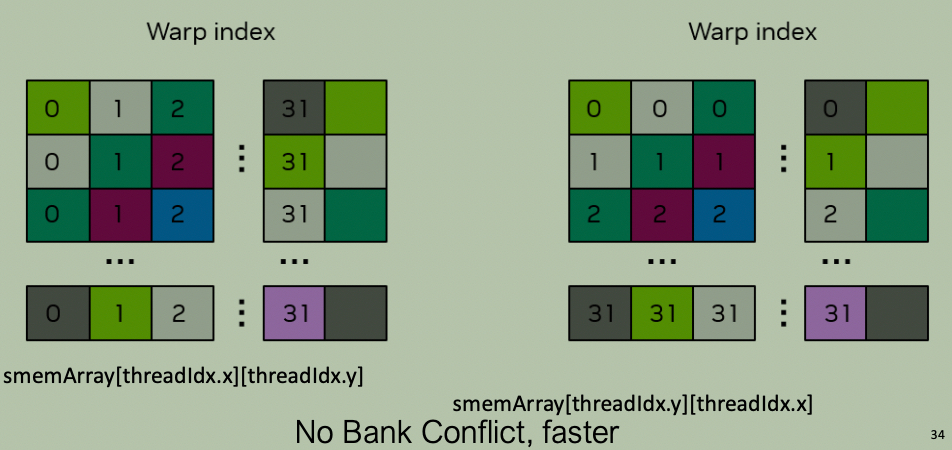
- 数组同一列由于 padding 的存在,不同行散落在不同 bank 上,消除了
shmem[tx][ty]模式访问的 bank conflict。
3. Sparse Matrix Multiplication
CSR (Compressed Sparse Row) 格式
- 背景:稀疏矩阵中绝大多数元素为 0,直接使用稠密矩阵存储和计算会浪费大量内存和带宽。
- CSR 使用三个一维数组(设矩阵有 m 行,非零元素个数为
nnz):
data:长度为 nnz,按行主序存储所有非零元素的值。col_index:长度为 nnz,存储每个非零元素对应的列索引。row_ptr:长度为 m + 1,存储每行第一个非零元素在data/col_index中的起始位置。row_ptr[i]到row_ptr[i+1]-1即为第 i 行的非零元素。
- 示例(4×4 矩阵):
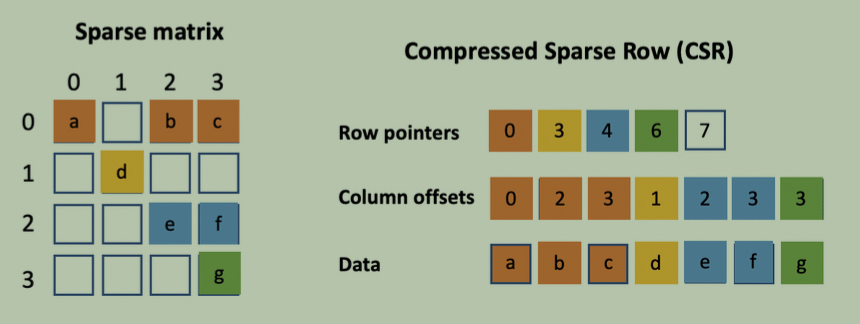
row_ptr = [0, 3, 4, 6, 7]col_index = [0, 2, 3, 1, 2, 3, 3]data = [a, b, c, d, e, f, g]- 第 0 行的非零元素在
data[0..2],对应列索引[0, 2, 3]。
Sparse Matrix-Vector Multiplication 算法(串行视角)
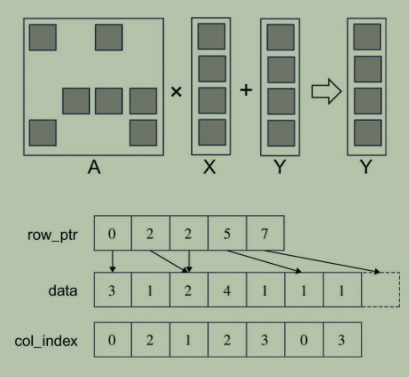
- 计算 \(Y = A \times X\)。
- 对每一行
row:- 获取该行的非零元素范围
[row_start, row_end)。 - 遍历该范围内的每个非零元素
ele,计算dot += x[col_index[ele]] * data[ele]。 - 将结果写入
y[row]。
- 获取该行的非零元素范围
1 | |
CUDA 实现(SpMVCSRKernel)
1 | |
- 线程映射:每个线程负责一行
row的计算。 - 边界检查:
if(row < num_rows)确保不越界。
性能分析
- 优点:
- 内存占用与计算量正比于非零元素数 nnz,而非 O(m n)。
- 避免了零元素的无效计算。
- 缺点:
- 非合并访问:
x[col_index[ele]]的访问完全依赖col_index,列索引不连续,导致对x的读取是随机的、非合并的。 - 负载不均衡:不同行的非零元素数量差异可能很大,有的线程计算量远大于其他线程,导致 warp 内线程负载不均衡,影响吞吐。
- 行间并行度受限:如果矩阵行数较少,难以将 GPU 的 SM 喂满。
- 非合并访问:
- 优化方向:
- 调整线程映射(如一个 warp 处理一行,利用合并访问)。
- 使用 ELL / JDS 等针对 GPU 优化的稀疏格式
4. cuBLAS
概述
- cuBLAS:CUDA Basic Linear Algebra Subroutine library(CUDA 基础线性代数子程序库)。
- 一个轻量级库,专用于 **GEMM 操作,同时也提供基础的向量和矩阵运算。
生命周期管理
必须在使用前调用:
1
cublasStatus_t cublasCreate(cublasHandle_t *handle)必须在结束后调用:
1
cublasStatus_t cublasDestroy(cublasHandle_t handle)所有 cuBLAS API 调用都需传入
cublasHandle_t handle。
核心 API
1. 向量点积(Vector Dot Product)
1 | |
- 计算 \(x \cdot y\)。
incx/incy:向量元素的步长(通常为 1)。
2. 矩阵-向量乘法(Matrix-Vector Product) 公式: \[ y = \alpha A \cdot x + \beta y \]
1 | |
trans:是否转置 A(CUBLAS_OP_N或CUBLAS_OP_T)。m/n:矩阵 A 的维度。lda:leading dimension of A(A 的列数)。
3. 矩阵-矩阵乘法(Matrix-Matrix Multiplication) 公式: \[ C = \alpha A \cdot B + \beta C \]
1 | |
transa/transb:是否转置 A / B。m/n/k:矩阵维度。lda/ldb/ldc:各矩阵的 leading dimension。
关键注意点
- 列主序(Column-Major):cuBLAS 默认使用列主序存储。如果数据是行主序(C/C++ 默认),通常需要利用转置参数或手动调整索引,这是常见的坑。
- 句柄(handle):所有 cuBLAS 函数都需要传入
handle,用于管理上下文和资源。 S前缀:cublasSdot、cublasSgemv、cublasSgemm中的S表示单精度浮点数(float)。对于双精度用D(如cublasDgemm),半精度用H(如cublasHgemm)。- 性能:cuBLAS 内部高度优化,通常使用 Tensor Core、Tiling、多级流水线等高级技术,性能远超手写 kernel。
cuBLASLt
- 定位:cuBLAS 的灵活扩展,专为 DL/ML 中的 GEMM 设计。
- 与 cuBLAS 的区别:
- 描述符 + 启发式 API,而非固定参数。
- 支持任意数据布局、FP8/FP4 等低精度格式。
- 支持 epilogue 融合(bias + 激活)。
- 核心 API:
cublasLtCreate/cublasLtDestroycublasLtMatrixLayoutCreatecublasLtMatmulDescCreatecublasLtMatmulAlgoGetHeuristic(查询最优算法)cublasLtMatmul(执行)
- 调优要点:
- 启发式结果建议缓存重用。
- workspace 大小可调(可能影响性能)。
- 不同问题尺寸的最优算法可能不同,建议 autotune。
5. Summary
- Tiling for efficient matrix computation
- Coalesced memory access
- Sparse matrix representation and multiplication
- cuBLAS
- readily available vector, matrix-vector, matrix-matrix operations
LLM Systems 04: GPU Acceleration
https://arcsin2.cloud/posts/2026/09/1906032670/