LLM Systems 02: GPU Programming
This article is the learning note of CMU 11868 LLM Systems course Lecture 2. For more details, please refer to the original slides.
0. Recap
- Autoregressive Language Model: \(P\left( x_{1..T} \right) = \prod_{t=1}^{T}{P\left( x_{t+1} | x_{1..t} \right)}\) .
- Scaling of LLMs: 0.1B -> 1000+ B, the need for system optimization.
- Important Topics in LLM systems
- Programming model
- relies on good abstraction
- Latency/Throughput
- Data movement
- Computation vs memory
- Reliability
- Security
- Programming model
1. Neural Network Layer and low-level operators
Take a simple feedforward neural network for sentiment classification task as example:
1 | |
The Embedding(lookup table) layer convert the input sequence tokens into embeddings, then feed the embeddings to later layers for computation.
The low-level operators behind these layers include:
- Matrix multiplication: Linear
- Element-wise ops (add, scale, ReLU): ReLU
- Reduce ops (sum, avg): Avg Pooling
Efficient computation requires GPUs.
2. Components of A GPU Server
A typical modern GPU server includes the following components:
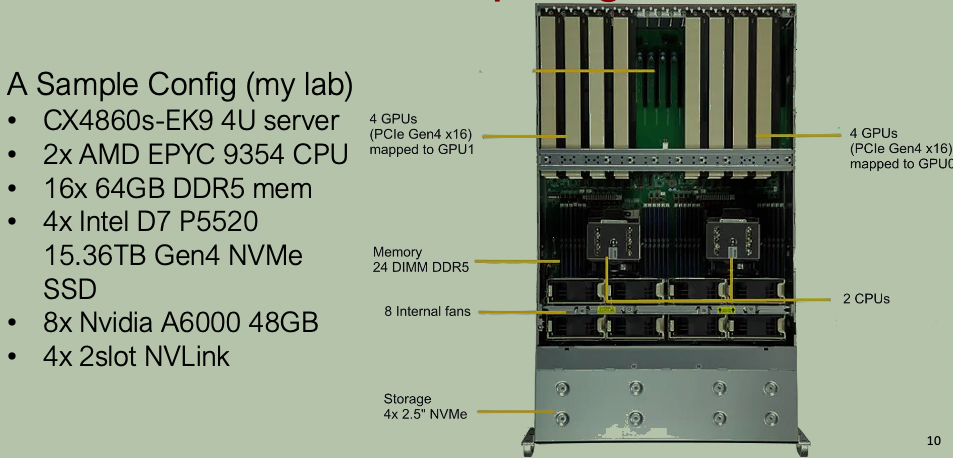
- 2 or more CPUs
- Several TB of CPU memory
- Tens of TB of SSD
- Usually 8 GPUs, interconnected via NVLink
- For the server in the above figure, the NVLink bandwidth 112.5 GB/s
- PCIe Gen4 32 GB/s (16 lanes x 2 GB/s per lane)
The hardware connection of CPU/GPU in a modern server is usually as follows:
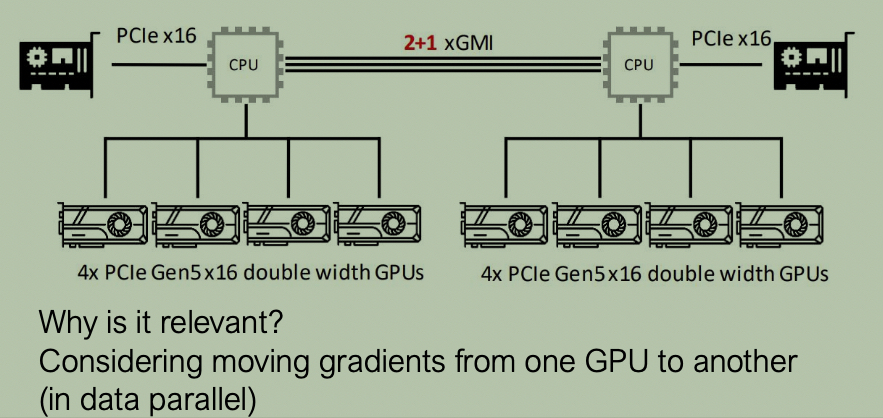
- Topology (from diagram):
- 2 CPUs connected via xGMI (2+1 xGMI). xGMI is the interconnect bus between AMD CPUs.
- Each CPU connects to 4 GPUs via PCIe Gen5 x16.
- Total: 8 double-width GPUs.
- No direct GPU-to-GPU interconnect (e.g., NVLink) shown; GPU communication must go through PCIe and CPU xGMI.
- Why relevant to Data Parallel training?
- In data parallel, each GPU computes gradients on its own batch, then GPUs must synchronize gradients (e.g., All-Reduce) to keep model replicas consistent.
- Moving gradients from one GPU to another requires crossing PCIe (and possibly xGMI across CPUs).
3. GPU Architecture
Some additional materials:
GPU Lineup
| Metric | NVIDIA B200 (Blackwell) | NVIDIA H100 (Hopper) | NVIDIA A100 (Ampere) |
|---|---|---|---|
| FP64 | 37 teraFLOPS | 34 teraFLOPS | 9.7 teraFLOPS |
| FP64 Tensor Core | 37 teraFLOPS | 67 teraFLOPS | 19.5 teraFLOPS |
| FP32 | 75 teraFLOPS | 67 teraFLOPS | 19.5 teraFLOPS |
| FP32 Tensor Core | 2.2 petaFLOPS | 989 teraFLOPS | 312 teraFLOPS |
| FP16/BF16 Tensor Core | 4.5 petaFLOPS | 1979 teraFLOPS | 624 teraFLOPS |
| INT8 Tensor Core | 9 petaOPs | 3958 teraOPs | 1248 teraOPs |
| FP8 Tensor Core | 9 petaFLOPS | 3958 teraFLOPS | - |
| FP4 Tensor Core | 18 petaFLOPS | - | - |
| GPU Memory | 192GB HBM3e | 80GB HBM3 | 80GB HBM2e |
| Memory Bandwidth | Up to 7.7TB/s | 3.2TB/s | 2TB/s |
| SMs | 148 | 132(SXM5)/114(PCIe) | 108 |
Streaming Multiprocessor(SM)
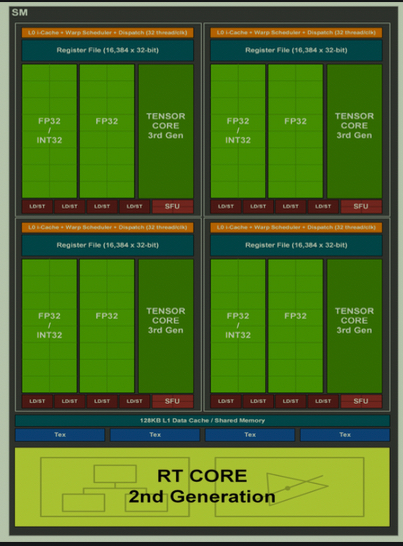
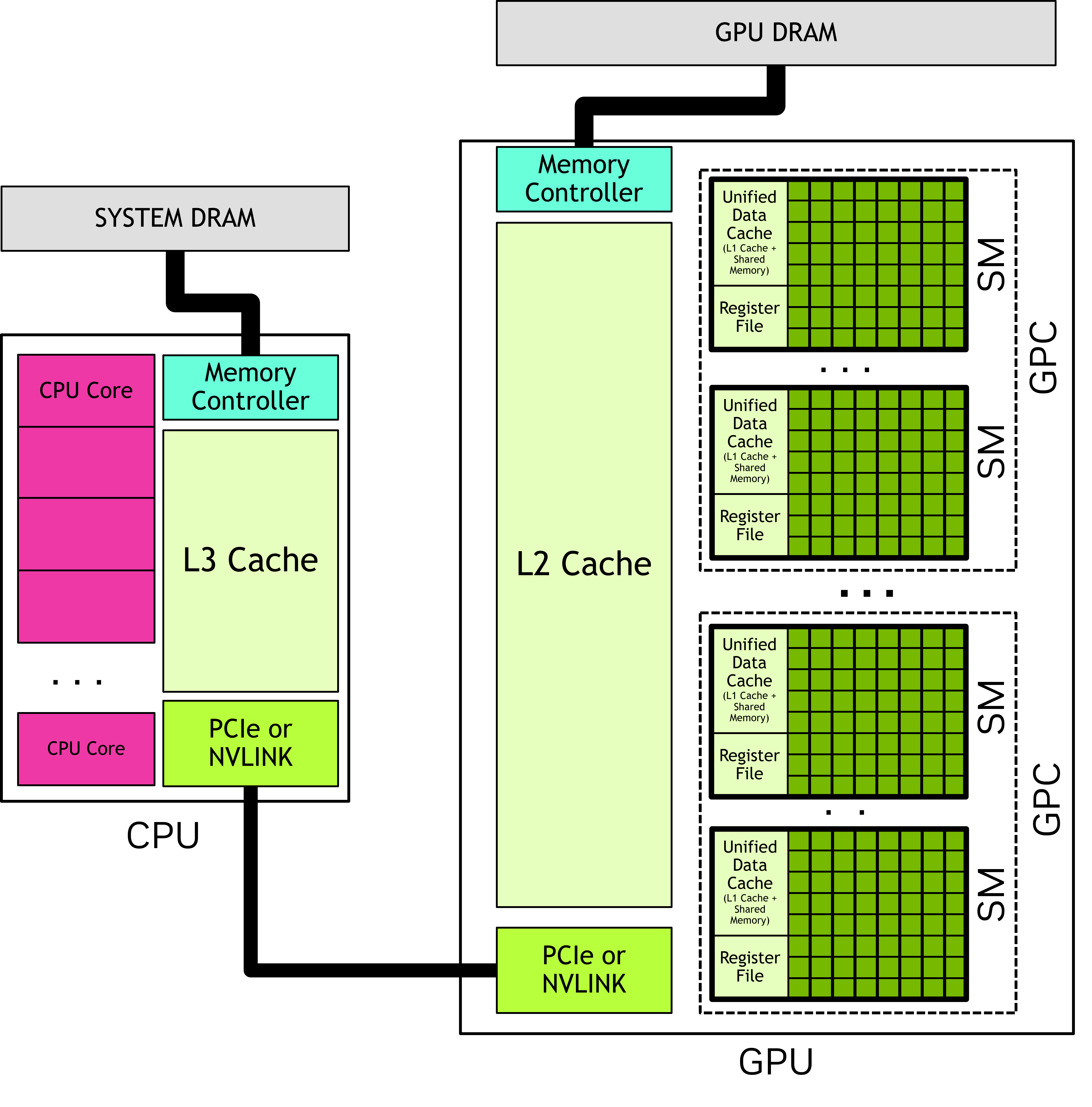
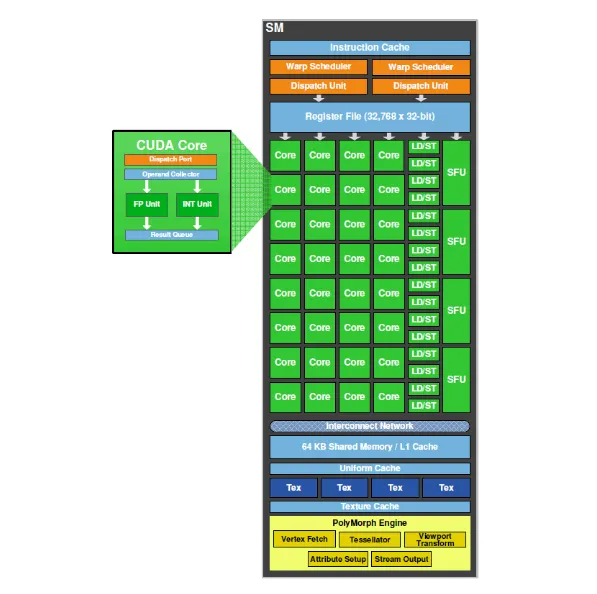
- SM: basic compute unit of an NVIDIA GPU.
- 4 partitions per SM:
- Each partition has 32 FP32 cores → 32 cores can execute one warp (32 threads) at a time.
- Total: 128 FP32 cores per SM.
- Registers:
- 64KB register file per partition (fastest storage).
- Total: 256KB register file per SM.
- Cache / Shared Memory:
- 128KB shared L1 cache per SM.
- 256KB shared L1 cache per SM for H100.
- Throughput:
- 128 FP32 operations per cycle per SM (one per core).
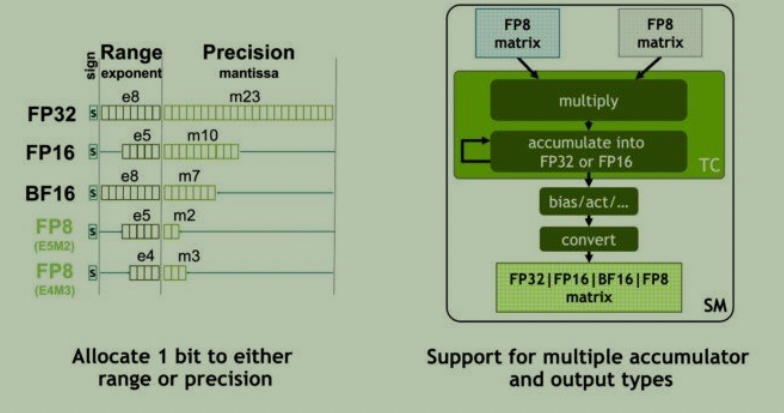
New in H100, FP8 operations
CPU vs. GPU
| Metric | CPU (AMD EPYC 9754) | GPU (A6000) |
|---|---|---|
| Number of threads | 256 | 10752 |
| Clock | 2.25 GHz | 1.8 GHz |
| Compute | 576 GFlops | 38.7 TFlops |
| Power | 360 W | 300 W |
4. Program Execution on GPU
GPU Programming Model
- CPU – host
- Run normal program (C++)
- GPU – device
- Run cuda kernel code
- CUDA: one part runs on CPU, one part runs on GPU
- Needs to move data between system memory and GPU memory
SIMT Execution on GPU
- SIMT = Single Instruction, Multiple Threads:
- One instruction is issued to many threads in parallel.
- Each thread processes different data with its own registers/state.
- Thread hierarchy:
- Thread: smallest execution unit.
- Warp: 32 threads; basic scheduling/issue unit.
- Thread Block: group of warps; scheduled onto one SM.
- Grid: group of blocks; launched by one kernel.
- Kernel execution:
- A kernel is executed as a grid of blocks of threads.
- Blocks are distributed across SMs.
- Warps within a block are scheduled onto SM partitions.
- Each partition issues one warp per cycle to its 32 FP32 cores.
- SIMT vs. SIMD:
- SIMD: one instruction operates on a vector of data.
- SIMT: one instruction executed by many threads, each with its own registers/PC; supports per-thread branching, but divergence costs performance.
How Kernel Threads are Executed
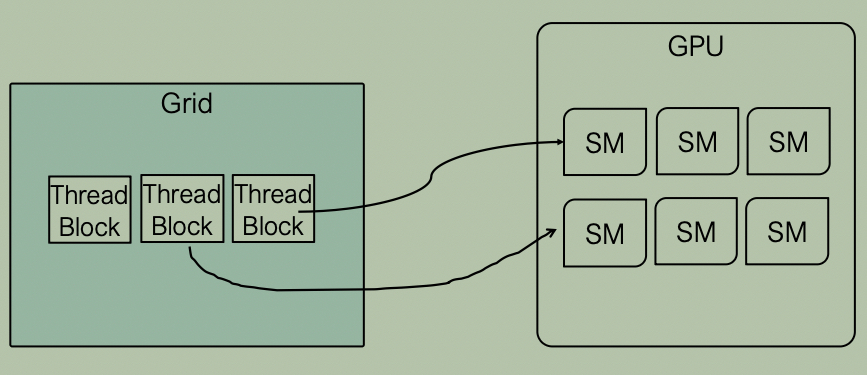
- Software-to-hardware mapping:
- A kernel launches a Grid of Thread Blocks.
- Thread Blocks are distributed across SMs on the GPU.
- An SM can host multiple Thread Blocks concurrently.
- Block → Warp partitioning:
- SM partitions a Thread Block into warps.
- Warp = basic unit of GPU creation, management, scheduling, and execution.
- Warp characteristics:
- Contains 32 threads (matches 32 FP32 cores per SM partition).
- All threads in a warp start at the same program address.
- Each thread has its own program counter (PC) and registers.
- Execute one common instruction per cycle (SIMT).
- Hardware implements per-thread PC via:
- Warp-level PC: current issued instruction.
- Active mask: which threads are active.
- SIMT / branch stack: tracks divergent paths, executes them serially, then re-converges.
- Hardware implements per-thread PC via:
- Threads can branch and execute independently:
- Divergent branches cause serialization (branch divergence), masking idle threads.
Warp Execution on GPU
- Execution context stays on SM for lifetime of warp
(Program counter, Registers, Shared memory)
- Once a warp is scheduled onto an SM, its context remains resident until the warp finishes.
- No need to swap context out to memory (unlike CPU).
- Warp-to-warp context switch is instant
- All resident warps' contexts are in SM registers/shared memory.
- Scheduler can switch to another ready warp every cycle.
- This is how GPUs hide memory latency: when one warp stalls, another runs.
- Warp scheduler at runtime:
- Chooses a warp with active threads (not finished, not blocked).
- Issues the warp's current instruction to its 32 threads.
- Goal: keep execution units busy and maximize throughput.
- Number of warps resident on an SM is limited by
resources:
- Registers per thread (register file size).
- Shared memory per block.
- Hardware limits (e.g., max 64 warps/SM on H100).
- More resident warps → better latency hiding; fewer → possible stalls.
- Key takeaway: GPU hides latency through massive hardware multithreading with zero-cost context switches, not through complex out-of-order execution like CPUs.
Executing one Thread block on one SM
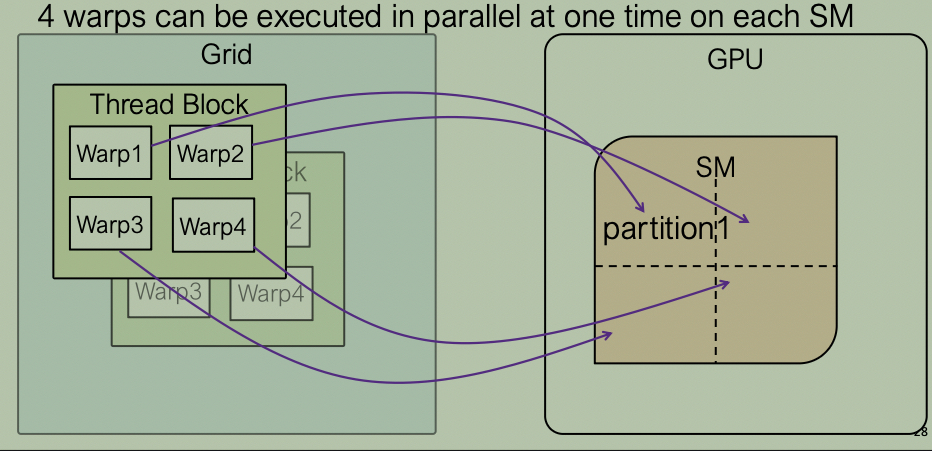
- Thread Block → Warp → SM partition mapping:
- A Thread Block contains multiple warps.
- An SM has 4 partitions, each can issue one warp per cycle.
- Therefore, up to 4 warps can execute in parallel at one time on each SM (one per partition).
- Diagram meaning:
- Warps (Warp1–Warp4) of a Thread Block are distributed across SM partitions.
- Arrows show warp → partition assignment.
- Each partition executes its assigned warp on 32 FP32 cores.
- Key points:
- A Thread Block may contain more than 4 warps; extra warps wait and are scheduled by the warp scheduler.
- Multiple Thread Blocks can reside on one SM, but the 4-partition issue limit still applies per cycle.
- This is the hardware basis of SIMT parallelism: many warps, 4 issued per cycle, hiding latency via fast context switching.
- Takeaway: One SM can issue up to 4 warps per cycle (one per partition). A Thread Block with ≥4 warps can fully utilize this issue width when scheduled on one SM.
CPU-GPU Data Movement
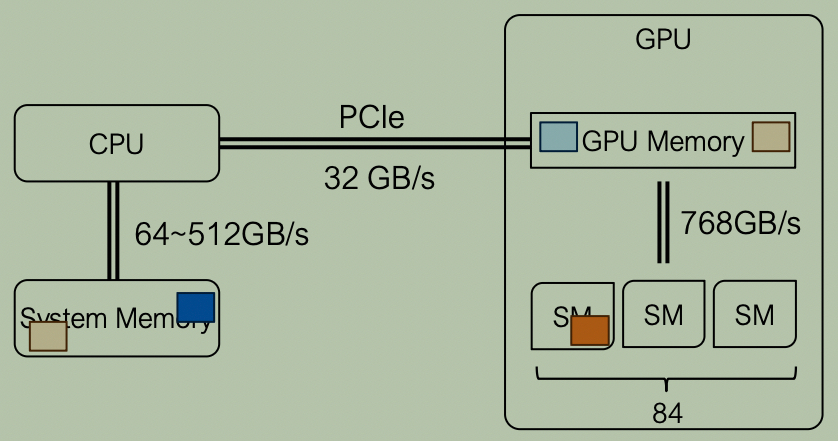
CUDA Kernel
- Each kernel is a function (program) that runs on GPU
- Program itself is serial
- Can simultaneously run many (10k) threads at the same time
- Using thread index to compute on right portion of data
Compiling CUDA Code
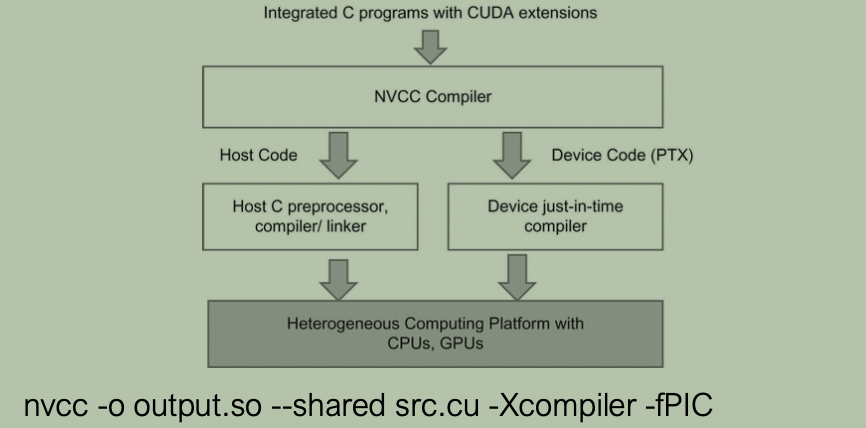
Summary
- Neural network
- is composed of layers, each layer defines input and output vectors/embeddings.
- Each layer’s computation consists of low-level operators, which is executed on a computing device (GPU, CPU, FPGA, etc).
- GPU is composed of
- streaming processing units (SMs)
- each with four partitions of 32 cores
- shared L1 cache
- memory
- L2 cache: share with all SMs
- streaming processing units (SMs)
- Threads organized in
- grid of thread blocks
- each block is divided into warps running in parallel on one SM.
LLM Systems 02: GPU Programming
https://arcsin2.cloud/posts/2032429701/